

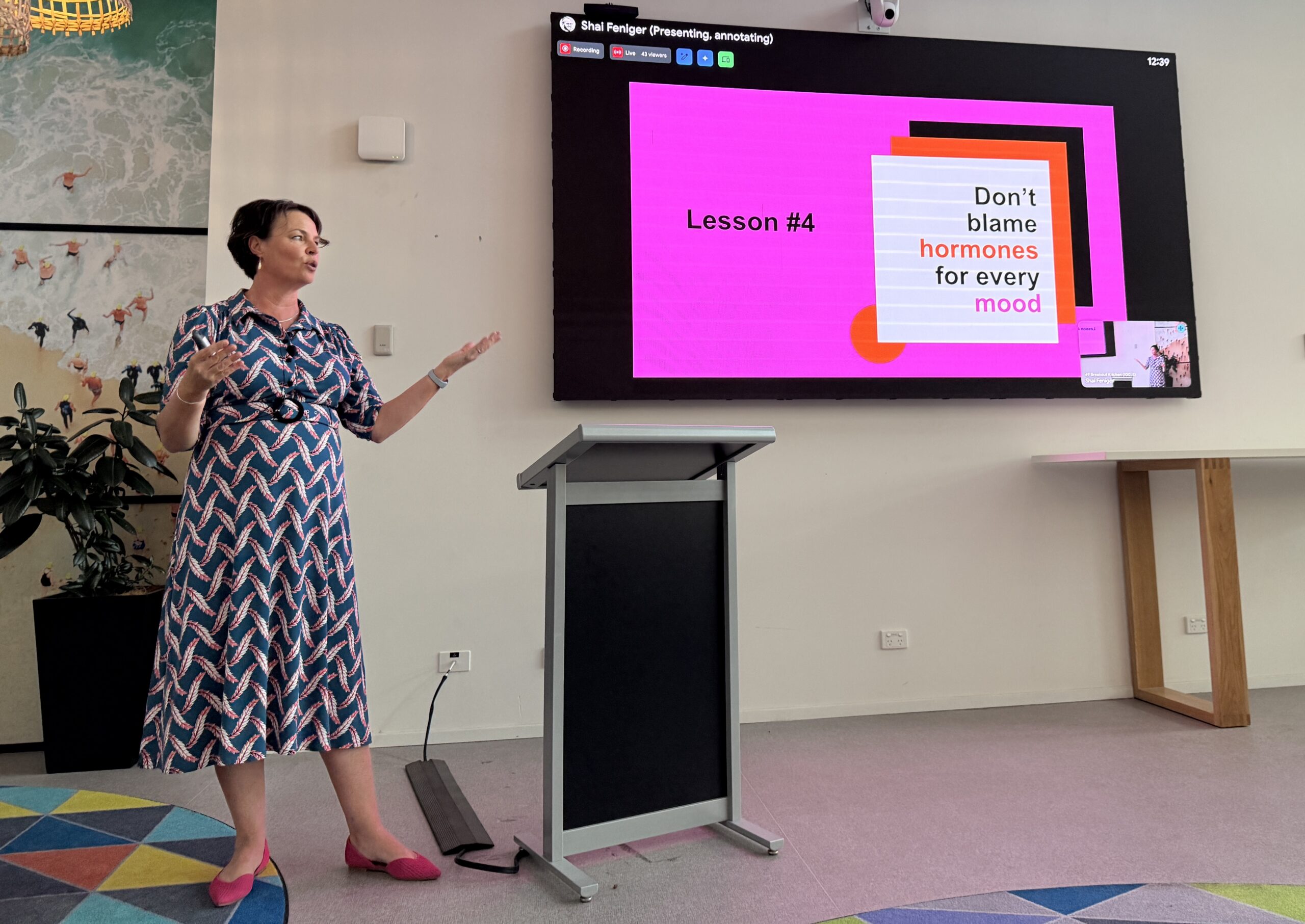
This week, I spoke at an International Women’s Day event about women’s brain health. I began by pointing out that women have been in neuroscience for generations. More than half of my undergraduate neuroscience class were women. But we haven’t always been inside the data. We’ve run labs, taught students and published research for decades. Yet our own biology, from puberty to pregnancy to menopause, was often treated as a complication rather than something worth studying directly. But that’s all changing rapidly (as you, dear reader, will be aware).
One place this gap shows up is in the language we use to describe women’s lives. This is why I’ve been proudly supporting the global campaign to get the word matrescence into dictionaries. The word describes the social, psychological, and neurological transition into motherhood, a transformation that has been discussed in science since the 1970s (that’s my entire life!), but still lacks everyday recognition. If you’d like to support the campaign and add your name, you can do that here: Sign the campaign.
Read on for this week’s neuro-news 👇
🏃♂️ ‘SuperAgers’ are people in their eighties and above who have exceptionally good memories. But what makes these SuperAgers’ brains so special? New research has shown that SuperAgers actively grow more new neurons in the memory centre of the brain, the hippocampus, than other healthy older adults. This extra neuron growth is thought to make them more cognitively resilient to the effects of ageing. Meanwhile, older adults with cognitive decline and Alzheimer’s disease had minimal to no new neurons. So, discovering how to boost neuron growth may be an effective strategy to preserve memory and cognitive function as we age. This research was published in Nature, with a non-academic summary here.
🙊 You may have seen the BAFTAs controversy in the news last week, where Tourette’s syndrome advocate John Davidson said a racial slur as a tic at two Black actors. There’s been a lot of online discussion about both the incident itself and how poorly it was handled by the BAFTAs and BBC. Yet it’s been clear that Tourette’s is still widely misunderstood. So, in this article for The Conversation, neuroscientist Dr Melissa Licari explains how Tourette’s presents and the different types of tics. Learn more: How Tourette’s causes involuntary outbursts – and what people with the condition want you to know.
🎙️ For decades, medical research has underrepresented and excluded biological females. This sex bias was in part due to reduced funding for research into diseases that predominantly affect women. Finally, we’re starting to see brilliant research into women’s brain health but there’s still a long way to go. In this episode of the Women’s Health Interrupted podcast, Dr Liisa Galea chats to Dr Kate Womersley about sex and gender equity in medical research, including the steps we need to take to continue closing the gap and how funding needs to drive change. Listen here: How Sex and Gender Bias Skews Medical Research.
🙋♀️ Many autistic women are late diagnosed, meaning that their autism was missed in childhood. A new Swedish study has assessed the rate of autism diagnoses in children and adolescents to look at the gender gap in this diagnosis. It found that there are around three boys diagnosed in childhood for every young girl with an autism diagnosis. But come adolescence, the ratio of autistic boys and girls are nearly the same, reflecting delayed diagnoses for autistic girls. More work is needed to close this diagnostic gender gap and to better support autistic girls and women. This study was published in BMJ, with a non-academic summary by The Transmitter.
🐝 One of the best statistical advantages for living longer is being a woman. Among centenarians worldwide, women outnumber men by a ratio of 9 to 1. This female advantage is not restricted to humans but is seen in other species; female honeybees, orca whales, and rodents all outlive males. But why is there a longevity gender gap? In this episode of The World as You’ll Know It podcast, host Carl Zimmer talks to ageing and women’s health specialists to discover how pervasive this gender advantage is, the genetic basis for it, and what it means for women as they age. Listen on Spotify here or read the show transcript here.
💬 “There are certainly cultural, behavioural, and environmental aspects to why women live longer than men. But given how extensive and pervasive this is and the fact that we see this in the animal kingdom, that female animals across the kingdom in many species will tend to live longer than the male animals, it tells us there’s something biological going on, that there’s some component of genetics or hormones that are contributing to the female longevity.” Prof Dena Dubal
Share the love
[Sassy_Social_Share]
About Dr Sarah
Neuroscientist, Author, Speaker, Director of The Neuroscience Academy suite of professional training programs.
Latest Posts
Free 10 day micro-training in neuroscience

Learn one neuroscience concept a day!
10 simple, bite-sized lessons in brain health, delivered daily to your inbox