

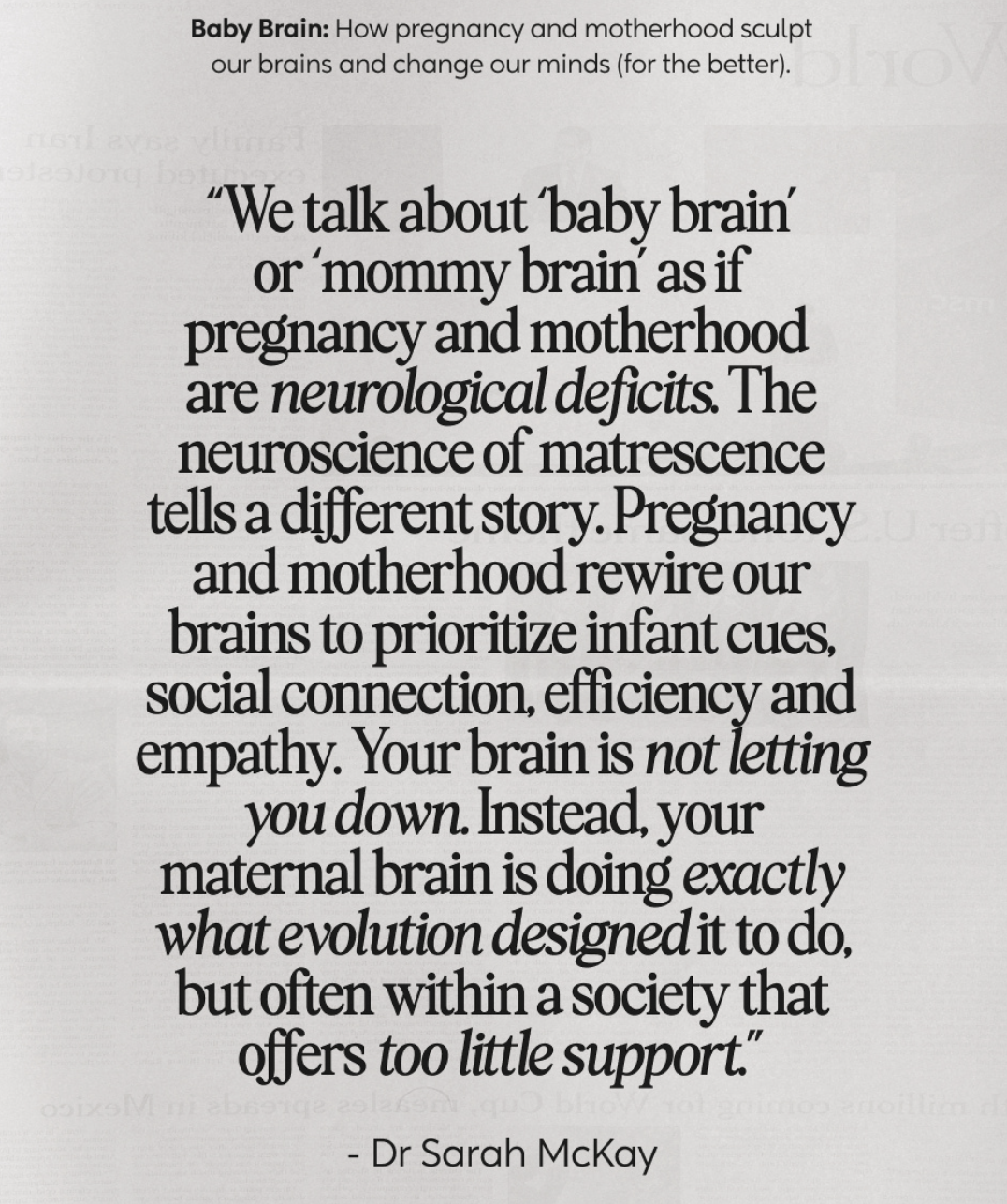
If you follow me on social media, you’ll see I’ve been proudly part of a new global campaign to raise awareness of the word matrescence and get it added to the dictionary.
The process of becoming a mother was coined as matrescence back in the ‘70s. Like adolescence, matrescence describes the social, psychological, and neurological transition into a new life stage: motherhood. But type “matrescence” into your phone, and you’ll see it shows up as misspelled + offering “no replacements”. Meanwhile, newer words and phrases like IDGAF, rizz, and even 6-7 are accepted without question. It’s time the word caught up to the science and the real lived experiences of mothers around the world. Click here to watch the video + add your signature to the dictionary petition!!
Read on for your Women’s Brain Health Briefing 🧠🔬
🤰 The rewiring power of matrescence isn’t just a feature of your first pregnancy. New research has shown that each pregnancy can rewire a women’s brain in a unique way, all leaving a lasting impact on her neurobiology. When women were pregnant for the first time, the main restructuring occurred within the part of the brain called the default mode network, which is involved in internal thoughts and social understanding. But a second pregnancy primarily changed areas involved in controlling attention and responsiveness, likely preparing for the demands of caring for two children. This work was published in Nature Communications, with a non-academic summary here.
📚 Do you lead a cognitively rich life? If so, I have some good ageing news for you. A new study has examined the link between lifelong cognitive enrichment and Alzheimer’s disease. It found that those who engaged in intellectually stimulating activities throughout their lives, like reading, writing, and learning a language, had a slower rate of cognitive decline later in life and a reduced risk of Alzheimer’s disease. This study was published in Neurology, with a non-academic summary by The Guardian.
👶 At birth, there are only very tiny differences between baby boy brains and baby girl brains. But over time, the differences grow. A new pre-print (not yet peer reviewed paper) has looked at male and female brains throughout the lifespan. Sex differences became more pronounced at puberty, with the entire timeline of sex differences aligning with the timeline of changing sex-hormone levels. However, the extent to which these differences are purely reflective of biological sex or also the impact of gender roles and experiences is still unknown. This preprint was published in bioRxiv, with a summary by Nature News.
🔬We’re yet to understand why women are more likely to develop Alzheimer’s disease than men. Researchers have now investigated early brain changes in cognitively healthy older adults. The work found fundamental differences in the initial cellular changes associated with Alzheimer’s disease, with elevated toxic protein levels in women compared to men. This work raises crucial concerns for the measurement and interpretation of set Alzheimer’s biomarkers in both men and women, emphasising the need to consider biological sex. This work was published in JAMA Neurology, with a summary on LinkedIn.
🧫 To examine neurological disorders in a petri dish, also known as in vitro studies, researchers need cell samples. However, more often than not, sex is not considered as a variable when selecting cells to culture. A new review is calling for cells from both male and female donors to be included whenever possible in in vitro studies to investigate sex-specific differences on a cellular level. This paper was published in Nature Reviews Bioengineering, with a summary from Scienmag here.
🦠 Women are more likely to experience longer-lasting pain and develop chronic pain disorders. This sex difference at least partly comes down to disparities in how the immune system works between men and women. Men’s immune cells release greater quantities of a molecule called IL-10, which tells pain-sensitive nerve cells to calm down. Men with more testosterone release greater IL-10, while the response is lessened in women. To learn more, check out this article in The Conversation: Why does pain last longer for women? Immune cells may be the culprit.
💬 “For decades, differences in pain between men and women have often been attributed to psychological, emotional or social factors. Because of that, persistent pain in women is often overlooked in care.” A/Prof Geoffroy Laumet
Share the love
[Sassy_Social_Share]
About Dr Sarah
Neuroscientist, Author, Speaker, Director of The Neuroscience Academy suite of professional training programs.
Latest Posts
Free 10 day micro-training in neuroscience

Learn one neuroscience concept a day!
10 simple, bite-sized lessons in brain health, delivered daily to your inbox