

Sign up for email micro-briefings in women’s brain health and neuroscience ➡️ Get Email Briefings
🧬 🄧🄧 Why are women more vulnerable to some neurological conditions, like Alzheimer’s disease and multiple sclerosis? Well, a new study in mice has identified a gene on the X chromosome that enhances brain inflammation. As women have two X chromosomes, compared to men who only have one, it’s theorised that women may get a ‘double dose’ of inflammation from the duplicate gene. Removing the gene also gave female mice more neuroprotection than male mice. This study was published in Science Translational Medicine, with a non-academic summary here.
😏 The unique struggles of ADHD women are historically understudied. But new research is finding that having ADHD makes women around three times more likely to experience premenstrual dysphoric disorder or PMDD. If women with ADHD also experience depression and anxiety, this risk is even greater. However, more research is needed to understand why women with ADHD have this heightened vulnerability to hormonal changes. To learn more about the link between the ADHD and PMDD, read this article in The Conversation.
🩸 The age that a woman gets her first period and reaches menopause can impact her mental health throughout her entire life. A new study has examined how these two biological landmarks in a woman’s life influences her mental health post-menopause. Women who had their first period before the age of twelve or after the age of fifteen had an increased risk of post-menopausal mental health problems, as did the women who hit menopause early. This research was published in Climacteric.
🤷🏻♂️ The more we study dementia, the more we realise it can’t be a one-size-fits-all approach. New research has explored sex-specific patterns of risk factors for Alzheimer’s disease to see whether men and women need different dementia prevention strategies. Women’s risk of Alzheimer’s was most impacted by blood pressure and apolipoprotein E or APOE ε4 status, with protective factors working together to reduce risk. Meanwhile, men’s risk of Alzheimer’s was most influenced by cognitive outcomes, suggesting key sex differences in dementia risk. The paper was published in Alzheimer’s & Dementia, with a summary by the first author on LinkedIn.
🎙️ The six-part The Fog and The Fury video podcast has reached its brilliant conclusion. The idea for this podcast was born during my last Neuroscience Coaching Network and watching the series come together has been both wonderful and insightful. In this final episode, the team of international coaches discuss what they’ve learned about menopause and ADHD from their interviews with scientists, medical professionals, and experts. You can watch it on YouTube here.
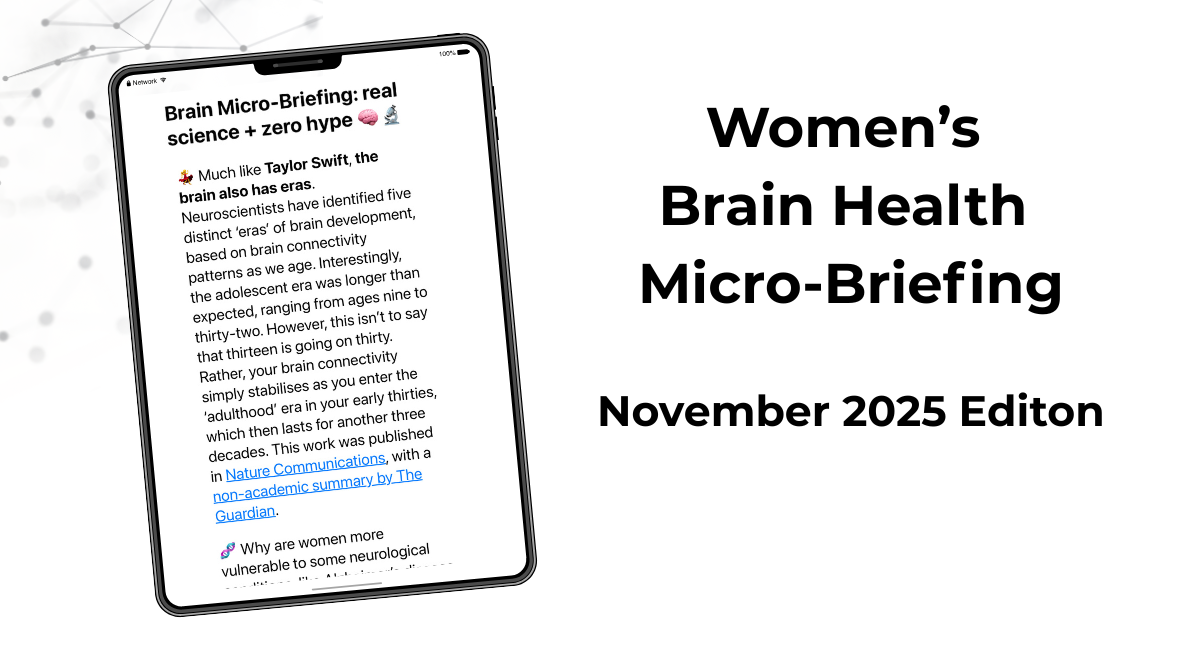
💃 Much like Taylor Swift, the brain also has eras. Neuroscientists have identified five distinct ‘eras’ of brain development, based on brain connectivity patterns as we age. Interestingly, the adolescence era was longer than expected, ranging from ages nine to thirty-two. Though this isn’t to say that thirteen is going on thirty. Rather, your brain connectivity simply stabilises as you enter the ‘adulthood’ era in your early thirties, which then lasts for another three decades. This work was published in Nature Communications, with a non-academic summary by The Guardian.
🫀 Women are far more likely than men to suffer from a stroke. So, a new study has used a ‘brain care score’ to try to predict which midlife women are most at risk of having a stroke. The brain care score measured modifiable physical, lifestyle, and social-emotional factors that impact brain health. The women who took better care of their brains in midlife did have a reduced risk of stroke over the next twenty years, even after adjusting for other cardiovascular risk factors. This study was published in Neurology, with a non-academic summary here.
🥵 During the menopausal transition, some women experience symptoms that disrupt their whole lives while others sail through. But do your menopausal experiences relate to your health in old age? In this article in The Conversation, discover the link between the number of perimenopausal symptoms and the risk of cognitive changes later in life. But always remember, correlation is not causation, and more research is needed to understand why this connection exists and what it means. Read it here: Menopause symptoms may be critical to understanding Alzheimer’s disease risk in women.
🧑🧑🧒🧒 Parents are more stressed and have worse moods than adults without children, yet they also report higher life satisfaction. Meet the parenting paradox! Wellbeing scientists have been trying to get to the bottom of the confounding parenting paradox to figure out why parents can be simultaneously distressed and fulfilled. This article by Scientific American explores the brain imaging research connecting brain connectivity changes and newfound feelings of meaning in life. Learn more: The Neuroscience behind the ‘Parenting Paradox’ of Happiness.
🌍 Only 0.1% of global brain health research originates from Africa, reflective of the wider bias in medical research towards studying Western populations. That is why it’s so exciting that The Female Brain Health and Endocrine Research in Africa (FemBER-Africa) project is now launching. This large-scale study will look at how sex, hormones, lifestyle, and cultural influences contribute to dementia risk for African women. To learn more about this first-of-its-kind study, read the protocol published in Alzheimer’s and Dementia.
🩸 From the start of puberty, girls are often told that periods are painful. But this expectation that periods should be painful means that many girls and women are left living with endometriosis, unbelieved by clinicians of their debilitating pain. This episode of ABC’s Ladies, We Need to Talk podcast explores the lived experience and medical misogyny of endometriosis, the need for greater awareness, and the research that’s hopefully paving the way for better treatments. Listen here: Endometriosis: Pain, periods, medical gaslighting.
🧟♀️ I spent a chunk of my weekend (weekend of 30th October 2025!) myth-busting that claim the brain ‘eats itself’ during menopause. This myth arose as a misinterpretation of research by Dr Roberta Brinton, which found (in rodents!) that the brain needs to find an alternative source of energy during the menopausal transition. But luckily women are not rats and hormone replacement therapy is not there to stop our brains from ‘eating themselves’. If you’ve been confused by this debacle, I debunked this myth in an Instagram live with Dr Jen Gunter, as did Dr Lisa Mosconi on a live with The Brain Docs.
📲 As I saw over the weekend, scientific misinformation can spread like wildfire on social media. This misinformation can have disastrous effects on people’s wellbeing, leading them to make poorer health decisions. To learn more about health misinformation, including how to spot it on your feeds, check out this article from The Conversation: Health misinformation is rampant on social media – here’s what it does, why it spreads and what people can do about it.
🤰 Around one in five new mothers will experience perinatal depression, either during their pregnancy or after birth. But it is difficult to identify those most at risk to give them timely help. New research has found that women who struggle with emotional regulation by mid-pregnancy, even without experiencing any other symptoms, are more likely to later develop depression. This suggests that assessing and improving emotional regulation skills during pregnancy could help identify and help those most at risk. This study was published in Nature Mental Health, with a LinkedIn summary by the first author here.
💊 Sometimes it seems like the world has gone mad for supplements. Creatine supplements have been doing the rounds in the women’s health sphere recently, with claims that extra creatine can help ease menopausal and menstrual symptoms. But is this neuro-hype or neuro-fiction? Well, there is early research suggesting that creatine supplementation can be beneficial for women’s brain health. But, as covered in this ABC News article, despite these potential benefits, most creatine supplements are well marketed but not necessarily well made.
🚶♀️ More steps equal better health, right? Yes, becoming more physically active is a good thing, but the way you achieve that activity is also important. A new study has found that getting your steps in through sessions of 10 to 15 minutes of walking has greater health benefits than reaching the same number of steps through shorter walking bursts of 5 minutes or less. So, if you are a bit of a couch potato, being more intentional with how you get your steps in may help to maximise the impact on your health. This research was published in Annals of Internal Medicine, with a non-academic summary by The Sydney Morning Herald.
🙆♀️ The menopausal transition can be difficult for some women. But autistic women are particularly understudied and under-supported yet are more likely to experience more severe menopausal symptoms. In this article by The Conversation, learn more about the unique experiences of menopausal autistic women, as well as the urgent need to provide adequate, neuro-affirming care. Read it here: Why menopause may be even tougher for autistic people – and what needs to change.
🎙️ ADHD women may also be more likely to struggle with menopause. This interplay of ADHD and menopause is the focus of the six-part podcast series The Fog and the Fury, created by five brilliant coaches from my Neuroscience Coaching Network. In this episode of the series, host Denise Medved chats to Prof Sandra Kooij about her research and treatment of ADHD women during menopause. Listen to it on Spotify here or watch on YouTube here.
Share the love
[Sassy_Social_Share]
About Dr Sarah
Neuroscientist, Author, Speaker, Director of The Neuroscience Academy suite of professional training programs.
Latest Posts
Free 10 day micro-training in neuroscience

Learn one neuroscience concept a day!
10 simple, bite-sized lessons in brain health, delivered daily to your inbox